The Floor Space Bargain: What a Storage Footstool Really Gives You Back
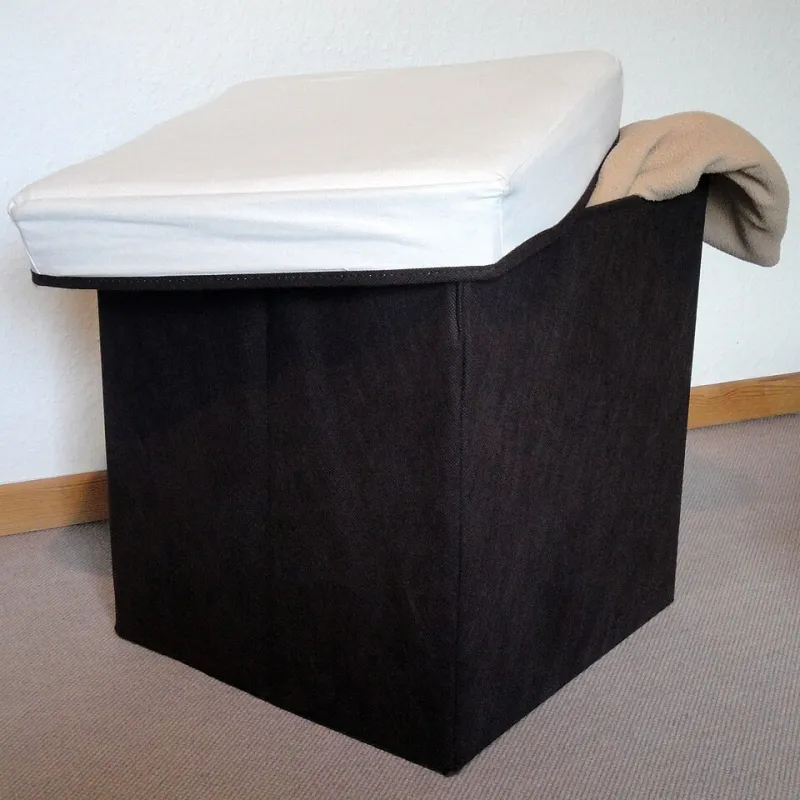
Photo: Reise Reise, CC BY-SA 3.0, via Wikimedia Commons
Every British living room is quietly running its own property market. Square footage is the asset, and everyone in the household is bidding for it — the dog's bed, the exercise bike nobody mentions, the stack of board games that only come out at Christmas. So when a footstool turns up claiming to be storage and furniture, it sounds like a rare bit of good news.
Sometimes it is. Often it isn't. The difference comes down to a handful of details that are almost never printed on the swing tag.
The floor space maths most people skip
Start with the footprint, because that's what you're actually spending. A fairly typical 90cm × 60cm ottoman claims 0.54 square metres of floor. In a 3.6m × 4m lounge — a common size in a 1930s semi — that's roughly four per cent of the entire room sitting under one piece of furniture.
That's not automatically a bad trade. A coffee table of similar size would take the same space and store nothing. But it only works if the ottoman genuinely replaces something else: the blanket box, the magazine pile, the wicker basket that's been quietly shedding since 2019.
If it's going to sit alongside all of those things, you haven't bought storage. You've bought a lid.
Lid mechanisms: the detail that decides whether you'll ever open it
This is where cheap ottomans fall apart, figuratively and sometimes literally.
Lift-off lids are the simplest and cheapest. No hinge to fail, nothing to snap. The catch is obvious the moment you use one: you need somewhere to put the lid down. In a small room, that means the sofa, the floor, or balanced precariously on one knee. Fine if you open it monthly. Annoying if you're in there daily.
Standard hinged lids are the middle ground, and worth checking carefully in the showroom. Does the hinge run along the long edge or the short edge? If it's on the long edge and the stool sits against a wall, the lid may swing into the wall or refuse to open far enough. Open it fully in the shop, exactly as you would at home.
Gas-lift and soft-close mechanisms are the pleasant ones — the lid holds itself open while you rummage. They cost more, and the struts are the wear point. Ask what happens if a strut fails and whether replacements are sold separately. A soft-close lid with a dead strut is just a heavy lid.
Flip-over lids with a tray underside are the clever compromise: upholstery one way up for sitting, a flat surface the other way for cups. Just be honest about how often you'll actually flip it.
One safety note worth taking seriously: heavy lids and small fingers don't mix. If there are toddlers or a curious cat in the house, a soft-close mechanism isn't a luxury.
What actually fits inside
External dimensions flatter these things badly. Walls, hinges, a base board and the lid's own thickness all take a bite. Expect usable internal depth to run 8–12cm shallower than the outside measurement, and plan around that.
A 40cm-tall ottoman might give you 30cm of usable height. That's plenty for throws, cushions, winter bedding, shoes, toys and the aforementioned board games. It is not plenty for A4 box files, tall vases, or a vacuum cleaner.
Shape matters too. Rectangular compartments use their volume efficiently. Round ottomans look lovely and waste every corner. If you're storing folded textiles, a rectangular box with a flat base will hold noticeably more than a drum of the same nominal capacity.
Before ordering, write down the three bulkiest things you intend to hide. Then check the internal figures against them. If the listing only gives external dimensions, ask.
Upholstery that survives being used as furniture
A storage footstool lives a harder life than a sofa cushion. It gets feet on it, cups on it, a tray dragged across it and occasionally a person's entire body weight landing on one corner.
- Velvet looks superb and marks if you so much as look at it in shoes. Choose it for a footrest, not a coffee table.
- Bouclé is having a long moment, but those loops snag on keys, velcro and pet claws.
- Leather and good faux leather wipe clean and handle drinks duty with far less drama. Cheaper faux leather can peel at stress points within a few years.
- Tight-weave linen blends and performance fabrics are the sensible middle: textured enough to hide scuffs, tough enough for daily use.
If the stool is doubling as a table, a rigid top or a decent tray is not optional. Condensation rings are permanent.
Two jobs at once — and the numbers that make it work
As a seat: check the stated weight rating, and not just the vague 'suitable for occasional seating' line. Look at foam density if it's listed; low-density foam in a lid goes flat within a year. Height matters too — a stool meant for sitting usually wants to land close to your sofa's seat height, typically somewhere in the low-to-mid 40s in centimetres.
As a footrest: height should be near your sofa seat height so your legs rest rather than dangle. Ten centimetres out and you'll feel it in your lower back by the second episode.
As a coffee table: measure the top surface against your actual tray and the width of two mugs plus a remote. It's astonishing how small 90cm feels once things are on it.
Measure before the van comes
Tape the footprint out on the carpet with masking tape and live with it for a day. Then check three things: the clear walking route past it (60cm is the usual comfortable minimum), the door widths if it's going upstairs, and whether the lid opens without fouling the sofa, a radiator or a curtain.
Finally, ask yourself one blunt question: will you open it at least once a week? If the answer is no, buy a coffee table and a shelf instead. If it's yes, a well-chosen ottoman is one of the few bits of furniture that genuinely gives floor space back — just make sure it's taking less than it gives.